Showing posts with label Ethnicity and Race. Show all posts

Wednesday, September 10, 2014

x The Transplanted by John Bodnar (The Progressive Era and WWI, Immigration, Ethnicity and Race)

The Transplanted: A History of Immigration Urban America.
by John Bodnar 

The Progressive Era and WWI

Immigration
Ethnicity and Race

Thesis:
Immigrants to urban America maintained a dynamic relationship with both their past culture and the imperatives of their present environment by creating a mediating "culture of everyday life" most evident in the structure and function of the immigrant family.

Specific examples/evidence that supports the thesis:
Despite that industrialization moved the work force out of the home, family remained central to labor as family and friends found jobs for one another. Wages were used to sustain the family unit. 

Summary:
Bodnar is attempting to correct the historic record of Progressive Era immigration to reflect the evidence that immigrants were not simply victims of circumstance, completely displaced, and alienated from any of the social cultural norms they were used to at home. In fact, their homeland had also changed dramatically and through their immigration the attempted recreate much of their society in this new environment.


What does this tell us about Immigration in the Progressive Era/WWI?

 Immigrants were often leaving their home that was experiencing profound change and disruption due to the new capitalist world order. While extreme upheaval to their lifestyle did occur, it was anticipated and much was done to attempt to reincorporate the social structures they were losing.
What does this tell us about Ethnicity and Race in the Progressive Era/WWI?

What parts of the book can be applied to lectures?

General Thoughts:

Excerpts from Book Reviews
"Emigration was a means for those who could afford it to sustain traditional family against the disruptions of the modern world. On the other hand, the immigrant family itself had to modernize. In either respect, immigrants were children of capitalism."

"Urban immigrant life was neither traumatized by modern capitalism nor fixed in primordial tradition but, rather, transformed by the dynamic between these forces."

My Highlighted Passages

Wednesday, September 3, 2014

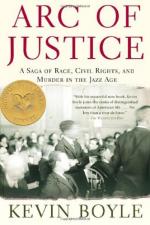
xArc of Justice: A Saga of Race, Civil Rights, and Murder in the Jazz Age by Kevin Boyle (Roaring 20's-WWII, Ethnicity & Race, Law)

Arc of Justice: A Saga of Race, Civil Rights, and Murder in the Jazz Age 
by Kevin Boyle 
Roaring 20's-WWII
Ethnicity & Race
Law
Arc of Justice: A Saga of Race, Civil Rights, and Murder in the Jazz Age by Kevin Boyle
Thesis:
Segregation was illegally protected in Northern cities that struggled to find a place for the wave black migrants coming from the South as part of the Great Migration.
The story of Ossian Sweet's struggle to find a home in the Northern  city of Detroit after the Great Migration demonstrates the racism and illegal segregation that became common place in Northern cities. Despite the blatant illegality of mobs attempting to violently dispell someone from a community based on race, the court battle for Sweet was still highly contested. Police tried to cover up evidence but in the end the law could not deny the innocence of the Sweets and their friends/family.

Specific examples/evidence that supports the thesis:


Summary:
Ossian Sweet
 During the 1920s, African Americans from the South poured into northern industrial cities such as Detroit. This migration triggered racial confrontations, as blacks began competing with whites over jobs, schooling, and housing. In 1925, one of those southern black migrants, Ossian Sweet, became a central figure in a confrontation that attracted national attention. Sweet, originally from Florida, was a doctor who sought to establish his practice in Detroit. After he moved into the home he had purchased in a white section of town, an organized mob stoned the house, and some members tried to break in. Anticipating trouble, Sweet had prevailed on friends to help defend his home. They were armed, shots were fired, and one white man was killed and another wounded. Police arrested Sweet, his wife, and nine other black men in the house. The trials that followed were ground breaking for legal challenge of segregation. National Association for the Advancement of Colored People (NAACP) raised money and recruited a legal team for the defendants. The Sweet case set a precedent for the NAACP’s subsequent strategy of using its new Legal Defense Fund to challenge segregation primarily through the courts.

What does this tell us about Ethnicity & Race in the Roaring 20’s-WWII?

What does this tell us about Law in the Roaring 20’s-WWII?

What parts of the book can be applied to lectures?

General Thoughts:

Excerpts from Book Reviews

"The narrative ranges widely to capture the many dynamic forces that were reshaping the American city and its race relations. These include a rapidly rising black population in Detroit; the role of the real estate industry in building ghetto walls; the use of restrictive covenants to enforce the color line; the significance of local homeowners’ associations in maintaining white neighborhoods; the resurgence of the Ku Klux Klan, not just in asserting white power but as a major force in Detroit politics; and the agency of some African Americans in challenging residential restrictions despite the dangers in doing so."


My Highlighted Passages

xThe Promised Land: The Great Black Migration and How It Changed America by Nicholas Lemann (Roaring 20's-WWII, Ethnicity & Race, Politics)

The Promised Land: The Great Black Migration and How It Changed America 
by Nicholas Lemann 

Roaring 20's-WWII
Ethnicity & Race
Politics


Thesis:
As Chicago, New York and other cities saw their black populations expand exponentially, migrants were forced to deal with poor working conditions and competition for living space, as well as widespread racism and prejudice. During the Great Migration, African Americans began to build a new place for themselves in public life, actively confronting economic, political and social challenges and creating a new black urban culture that would exert enormous influence in the decades to come.
 
Specific examples/evidence that supports the thesis:

 
Summary:
This book covers the Great Black Migration mostly from 1940's onward. The author takes specific examples of people moving from Mississippi to Chicago to exhibit the larger phenomenon The stories demonstrate how racism and racial tensions become paramount issues in the North as well as the South. The author found that officials in the North were slow to respond to mounting tensions.
After reconstruction, share cropping became the new system to continue free African American labor on plantations in the South. Instead of direct slavery, share croppers worked an entire season for the plantation owner, agreeing to get paid once the harvest occurred. In the mean time, they borrowed money for goods/food to survive and once the crop was sold the plantation owner would settle up. However, most often, the share cropper got virtually nothing or found they owed more than they made.
The plight of the sharecroppers increased due to technology in harvesting cotton, as well as a boll weevil epidemic that caused massive crop damage in 1898. In the 1920's-1940's the Hobson Plantation in Mississippi experimented with mechanized cotton growing and harvesting equipment. Eventually this developed into a fully mechanized system to grow and harvest which made the need for labor and share cropping dissipate.
With less job opportunities in the rural south and so many share croppers struggling to get by and the rise of industrialization in the North, many African Americans began to make their way north.  
This extended the issues of racism and segregation on a large scale to the Northern half of the United States. 
Cities began to section off parts of the city for exclusively black Americans to live.
What does this tell us about Ethnicity & Race in the Roaring 20’s-WWII?
 Lemann places much of the blame for black urban poverty and social pathology on both the oppressive racism of the South, which handicapped black migrants from birth, and on the exclusionary racism of the North, which tried to bar blacks from jobs, neighborhoods, and schools. He believes that the destitution of Northern blacks in the ghetto in the 1980's and 90's is a result of a long history of struggle in the sharecropper system and then the racially segregated North where oppurtunities for advancement quickly dried up. The welfare state became the crutch and a staple of urban black survival.
What does this tell us about Politics in the Roaring 20’s-WWII?
Lehmann discovered a pattern of black dependence on the welfare state while doing an article for a magazine. To investigate this further he interviewed families going back to the Great Black Migration. He discovered that sharecropping instilled a since of dependency because they were not payed a wage until after harvest meaning they took loans from the land owners for everything they needed to survive. Coming to the North they found jobs were difficult to find, and fair treatment and wages were non-existant. Black were still segregated to their own parts of town and authorities did little to fight against the illegal segregation and discrimination occuring in the North. As situations worstened many black migrants had no choice but to rely on the welfare state, a pattern which has continued today.
What parts of the book can be applied to lectures?

General Thoughts:

Excerpts from Book Reviews

 "From his account one could easily get the impression that the mechanical cotton picker alone was responsible for the migration, and that it all began in 1940. Yes, the picker was important and so were the 1940s, but the migration had been going on for decades, and there were many causes. Marcus Garvey, who had thousands of Black followers in northern cities in the 1920s, is not mentioned. The words "boll weevil" do not appear. Nor was the Community Action Program all there was to the War on Poverty."


My Highlighted Passages

xThe Souls of Black Folk by W.E.B. Du Bois (Progressive Era and WW1, Ethnicity and Race)

The Souls of Black Folk
by W.E.B. Du Bois

Progressive Era and WW1
Ethnicity and Race

Thesis:
"The problem of the Twentieth Century is the problem of the color line." DuBois believes the U.S. still has a great deal of work to do, to correct the problems of incomplete reconstruction and integration of African Americans into society after emancipation. 


Specific examples/evidence that supports the thesis:


Summary:
Co-Founder of the NAACP in 1909, Du Bois was the first African American to receive a doctorate from Harvard. He published The Souls of Black Folk in 1903 to discuss the failures and shortcomings of post emancipation reconstruction/integration. 

What does this tell us about Race and Ethnicity in the Progressive Era?
The Progressive Era is generally viewed as the 1890's to the 1920's, a time when the rapid industrialization of the U.S. left many citizens concerned with social reform and politics. Written in 1903, The Souls of Black Folk is a representative piece that demonstrates the movement towards social equality for American blacks trying to integrate with society since emancipation. DuBois describes the current state of the black man in society in the early 20th century. Through his own observations and travels, DuBois found that black people were not truly receiving what was promised to them (education, fair wages, justice, and protection under the law). DuBois, a highly educated man saw education and political involvement as the key to correcting the wrongs of slavery's past. 

What parts of the book can be applied to lectures?
DuBois, like Douglas, was there. His accounts are a primary source that paints a picture of what was going on in the early 20th century. DuBois was also a historian and he analyzes the strengths and weaknesses of reconstruction policy.  

General Thoughts:

Excerpts from Book Reviews


My Highlighted Passages

"Henceforth, the destiny of the race could be conceived as leading neither to assimilation nor separatism but to proud, enduring hyphenation."

Tuesday, August 12, 2014

Ida, A Sword Among Lions by Paula J. Giddings (Progressive Era-WWI, Ethnicity & Race, Gender & Sexuality)

Ida, A Sword Among Lions 
by Paula J. Giddings

Progressive Era-WWI
Ethnicity & Race
Gender & Sexuality


Thesis:
Ida B. Wells was an incredibly significant Progressive player in the issues of racism and gender equality at the turn of the 20th Century. Her work against African American lynching is of the utmost importance but it is also, often overlooked.

Specific examples/evidence that supports the thesis:


Summary:
This book discusses the life of Ida Wells. Daughter of freed slaves, her life and her story spans from the post Civil War Reconstruction through to the beginning of the Great Depression. 
Ida's life was full of challenges, her parents were killed when she was 16 by an outbreak of Yellow Fever. At that time she quit school to become a teacher and care for her siblings. Ever bitter by the hand she was dealt, Ida became an outspoken woman unafraid of speaking out against perceived wrongs. “Throughout the remainder of her life, she struggled to turn the negative emotions of abandonment into a righteous determination to reform herself and the society that had forsaken her race.”
She moved to Memphis where she made her first public attempt to challenge racist notions. Aboard a train she was asked to move to the "Jim-Crow" car but refused on the argument that it was crowded and people were smoking in there. They forcibly removed her and she sued the rail company. She eventually lost the suit in the Supreme Court of Tennessee. This further emboldened Wells about the injustice inherent in the post-Reconstruction South. 

 
In 1884 she was asked by the conductor of the Chesapeake & Ohio Railroad Company to give up her seat on the train to a white man and ordered her into the smoking or "Jim Crow" car, which was already crowded with other passengers. Despite the 1875 Civil Rights Act banning discrimination on the basis of race, creed, or color, in theaters, hotels, transports, and other public accommodations, several railroad companies defied this congressional mandate and racially segregated its passengers. It is important to realize that her defiant act was before Plessy v. Ferguson (1896), the U.S. Supreme Court decision that established the fallacious doctrine of "separate but equal," which constitutionalized racial segregation.
As a platform to speak frankly about the injustice she co-owned the Free Speech newspaper. When three of her friends were lynched for their competing grocery store taking business from their white neighbors, she was outraged. She began writing articles documenting the illegal violence of lynching so common in the South. Her life was threatened because of her articles. 
What does this tell us about Gender in the Progressive Era-WWI?
As an African American Women in the Jim Crow South before women has the vote, Wells' public role was unique. 
While temperance was not a passion of Wells, she worked in association with WCTU (Women's Christian Temperance Union) to promote women's rights and suffrage.

What does this tell us about Race and Ethnicity in the Progressive Era-WWI?Although the atrocities against African Americans were extensive, there were few spoke out against them. Wells' anti-lynching speaches, articles, and eventually her published work in 1892, "Southern Horrors: Lynch Law in All Its Phases" brought to light how extensive the atrocities had become.

What parts of the book can be applied to lectures?

General Thoughts:

Excerpts from Book Reviews


My Highlighted Passages

Thursday, July 24, 2014

War Without Mercy: Race & Power in the Pacific War, By John Dower (Roaring 20's-WWII, Ethnicity & Race, Military & Foreign Policy)

War Without Mercy: Race & Power in the Pacific War 
By John Dower 

Roaring 20's-WWII
Ethnicity & Race
Military & Foreign Policy

Thesis:
 Racism between the West and Asia made the war in the Pacific particularly merciless and brutal. Widespread wartime atrocities and civilian casualties were justified by racist sentiment that promoted the idea that this is what was required to defeat such an uncivilized foe. This thought process went both ways, West towards Asia, and Asia towards the West.
 
Specific examples/evidence that supports the thesis:


Summary
The author first describes the methods of propaganda that were inspired by racism and how these impacted the soldiers and the battlefield. The war was much more brutal with civilian casualties and war atrocities committed on both sides. Americans believed that the Japanese needed to exterminated like vermin not reprogrammed like the Germans. They believed that the only good Japanese were dead Japanese. The irredeemable quality of Japanese in the minds of Americans was unique. This was why even American citizens were placed in internment camps if they were of Japanese origin.
The Japanese felt that they were a pure people not diluted like the intermixed brutes of America. They saw the way Westerners conquered Asian people and felt they had no right to rule them. Japan felt they were the best fit to rule the Asian world.
Once the author established the racist attitudes back and forth between the Japanese and the Americans and how it ultimately led to a viciously brutal war, the author describes how these ideas were subverted into ideologies that fostered a peaceful occupation and thereafter a relatively friendly relationship between the two nations. The US once again found their mission to bring up a lesser people and act as the big brother. The US sought to bring the benefits of capitalist individualism to Japan.
 
What does this tell us about Ethnicity and Race in the Roaring 20's-WWII?
The racism of the of Pacific Theater of WWII demonstrates how Americans refused to see any Asian people as equal. Before Pearl Harbor, they believed that there was no way that the Japanese had any real power when compared to the West. After Pearl Harbor they were viewed as all following a single mind (the emperor) and empowered with no fear of death and an all sacrificing sub-human quality. Within the United States, the treatment of Japanese or even just anyone with Asian decent was terrible and got worse with Pearl Harbor. This was much different than people of German heritage. The atrocities committed on both sides of the battlefield were justified by racism. Here the ideas of scientific racism are present, advocating a stronger race that should rule over lesser peoples.
What does this tell us about Military & Foreign Policy in the Roaring 20's-WWII?
The author convincingly argues that the US policy in war towards Japan was hugely influenced by racism. The use of two atomic weapons when the war was clearly already won was justified with racist sentiment that this different type of people had to be completely subdued to the point of unconditional surrender. They had to agree to sacrifice their way of life and potentially their emperor. 

What parts of the book can be applied to lectures?
Frank Capra documentary, Know Your Enemy - Japan

General Thoughts:
It was really interesting that in this situation the US turned the Chinese into good guys (although still lesser people). The Chinese could be molded into good people but the Japanese had no hope of that.

Excerpts from Book Reviews
"Dower is exploring the propaganda of the US-Japanese conflict to delineate the "patterns of a race war," the cultural mechanisms of "othering," and the portability of racial/racist stereotypes."

"Yellow, Red, and Black Men" examines the notions of racial difference occupying the American mind since Columbus. More specifically, Dower outlines the concept of race war and the "Yellow Peril," and how this peril had become encoded in American immigration law."

"Once the war started, of course, the dehumanization of the enemy in the Pacific led to many notable atrocities on both sides of the conflict, from the infamous Bataan death march to the collection of noses, ears, teeth, and skulls by Allied soldiers, from the execution of three Doolittle Raid flyers to the slaughtering of surrendering Japanese at Bougainville. As Dower notes, these wartime atrocities spawned a vicious circle that, once publicized, led to more and more atrocities."

"Dower's study is fascinating. He shows the  interaction of racist ideas. To the Japanese, 
Japan's homogeneity, common purpose, corporate unity, and will were evidence of Japan's purity of race; to the Americans they were proof of Japan's primitiveness and uncivilized status. Americans, on the other hand, glorified individualism, creative entrepreneurship, and maximum individual liberty, all proof to the Japanese of America's racial heterogeneity and inability to mobilize its people to pursue anything morally worthwhile."

"How could such a savage killing frenzy as marked the final year of the war in the Pacific have been followed so suddenly by what still appears to be a benign occupation and subsequently friendly relations? The code words and images were malleable, he answers, and could be turned almost inside out. The yellow ape could become a pet, insanity could be cured with tender care, and the child could be shown how to mature-all expressions of American generosity, but also of American superiority. The Japanese did no less. The emperor invoked the national polity when he asked his people to endure the unendurable in defeat. The imperial institution was preserved, and Japanese began anew the struggle to find their rightful place in the world hierarchy."

My Highlighted Passages

"the Japanese were more hated than the Germans before as well as after Pearl Harbor. On this, there was no dispute among contemporary observers. They were perceived as a race apart, even a species apart -- and an overpoweringly monolithic one at that. There was no Japanese counterpart to the 'good German' in the popular consciousness of the Western Allies." (8) 

"as the war years themselves changed over into into an era of peace between Japan and the Allied powers, the shrill racial rhetoric of the early 1940s revealed itself to be surprisingly adaptable. Idioms that formerly had denoted the unbridgeable gap between oneself and the enemy proved capable of serving the goals of accommodation as well." (13)

"At the simplest level, they dehumanized the Japanese and enlarged the chasm between 'us' and 'them' to the point where it was perceived to be virtually unbridgeable." 

"transitions and juxtapositions in the Western image of the Japanese were abrupt and jarring: from subhuman to superhuman, lesser men to supermen. There was a common point throughout, in that the Japanese were rarely perceived as being human beings of a generally comparable and equal sort." (99)

"the metaphor of the child was used in a manner that highlighted the overlapping nature of immaturity, primitivism, violence, and emotional instability as key concepts for understanding the Japanese." (143)

"Where racism in the West was markedly characterized by denigration of others," writes Dower, "the Japanese were preoccupied far more exclusively with elevating themselves. While the Japanese were not inadept at belittling other races and saddling them with contemptuous stereotypes, they spent more time wrestling with the question of what it really meant to be 'Japanese,' how the 'Yamato race' was unique among the races and cultures of the world, and why this uniqueness made them superior."(204-205)

"the Japanese presented themselves as being 'purer' than others -- a concept that carried both ancient religious connotations and complex contemporary ramifications," (231-232)

"the Anglo-Americans were described as demons (oni), devils (kichiku), fiends (akki and akuma), and monsters (kaibutsu.)" (244)

"Despite such differences(in what tactics of racist rhetoric were used), however, the end results of racial thinking on both sides were virtually identical -- being hierarchy, arrogance, viciousness, atrocity, and death." (180) 

"To the victors, the simian became a pet, the child a pupil, the madman a patient."

Monday, June 30, 2014

The Blood of Government by Paul Kramer (The Progressive Era & WWI, Military and Foreign Policy, Ethnicity and Race)

The Blood of Government
 by Paul Kramer 

The Progressive Era & WWI
Military and Foreign Policy 
Ethnicity and Race


Thesis:
Kramer argues that the US involvement in the Phillippines and colonial mother country status was inextricably linked to racist sentiment. 

Specific examples/evidence that supports the thesis:
Despite the Filipino people repeatedly displaying their aptitude for self-rule, America refused to grant independence and colored them as backwards an uncivilized. The evidence strongly supports his thesis. The Filipino people were highly educated and politically had learned a great deal from serving in the colonial government with Spain. They were much more civilized than they were given credit for. Minority populations (like extinct headhunters) were used to demonstrate the uncivilized nature of Filipinos and justify US involvement.

Summary:

Despite the rare discussion about the American Filipino War, it is a vastly significant moment in U.S. history. This war gave birth to the American Empire and brought American into competition with the world powers.

American military came into the Philippines under the pretense that they would help them establish independence from Spanish rule. The Philippine Revolution began in 1896, to gain sovereignty from the Spanish.
Aguinaldo was a Filipino revolutionary that rose to lead the independence movement in 1796, eventually he negotiated assistance from US Navy Commander Dewey only to be manipulated into an alliance that led to a trade of imperial overseers instead of independence. Eventually he became a hero of Filipino people because of his commitment to gain independence.
During war with Spanish, the US made a secret deal to turn over the colony as log as the Spanish in Manila were spared.

The Filipino ambassadors petitioned the world to support independence.
During Spanish occupation the Filipinos developed their education and began to lay the foundation for independence with more leaders in the colonial government and highly educated mestizo class.
The African American treatment in America made Filipinos weary of American occupation, fearing they would be turned into a slave class.
Eventually some of the revolutionaries attacked the occupying American forces giving them the perfect opportunity to declare war on the savage, uncivilized people who needed proper government and education provided for them, as they would never be able to do it themselves. (A common excuse for imperialism)
Racism played a major role in the war. Soldiers called Filipinos "niggers" and abused, tortured, and killed them far outside the rules of civilized warfare. Their defense was that the race was lesser and could not be fought using normal civilized rules of combat. Torture was often used by Americans as pictured below...

During the ongoing war with the Philippines, the US decided to exhibit their new colony in the Pan-American Expo to show the world that they were an empirical power and to show that they were participating in civilizing the world.
The
With American colony status established, the officials went about educating the Filipinos in American history and world supremacy, painting Americans and Filipinos as brothers. Of course America as the older brother, showing them the way of the world. Policy went about saying that once the Filipino people were capable of self rule, it would be given to them. In fact, this was America's way to justify their presence as benevolent and not made up of self-interest. As time went on, the Filipino people proved themselves time and again ready for independence. Not wanting to fuel the fire of the uncivilized claim, the desire for independence was repeatedly presented politically to the heads of state who always agreed that when they were ready, independence would be granted.
In 1916, The Jones Act gave Filipinos more representation in their own government and assured them that independence was the US goal for them.
Eventually the Filipino cause gained ground in the US but only by those threatened by the cheap Filipino exports and or the labor provided by Filipinos who came to America under policies that allowed for their immigration because they are citizens of a colony, also the nativist sentiment that wanted to exclude any people of Asiatic decent from entering the country and or gaining citizenship. It was only after WWII and the end to the Japanese occupation of the Philippines that the US finally agreed to independent status of the Philippines.
What does this tell us about Military and Foreign Policy in the The Progressive Era/WWI?
America's colonial interest was driven mostly by a desire to be viewed as a world power after industrializing. American's also saw themselves as a special people who's democratic freedom loving christian lifestyle should be spread to the less fortunate (manifest destiny extended). Spreading dominion to the Pacific made sense because it gave America a strong hold in Asia. 
Foreign policy towards undeveloped countries was much like the rest of the industrialized world at this time, COLONIZE under the guise of humanitarian intentions. This was especially true in the Philippines, where America came in to "help Filipinos establish their independence from Spain."

What does this tell us about Ethnicity and Race in the The Progressive Era/WWI?
The way the American's treated the Filipinos in the colony as opposed to in America demonstrates the real ethnic racism taking place in America. Many of the soldiers who went to the Philippines after the colonial government had been installed, found that Filipinos were often well educated and intelligent, calling them their little brown brothers. In America, on the other hand, Filipinos were generally considered in the same class as the Chinese and Japanese who experiences the worst atrocities of racism. They found it hard to get jobs, did not receive a fair wage, couldn't get housing, and sometimes were the victims of violence. Americans campaigned against Filipinos who they claimed took their jobs and had an affinity for white women.


What parts of the book can be applied to lectures?

General Thoughts:
The author argues that the colonial relationship with the Philippines drastically changed the United States as people were exposed to an Asianic other that proved to be civilized and educated and not fit into the racist stereotypes so embedded in American popular culture at that time. While I agree that the people who had intimate interactions with the majority of Filipino colonial immigrants or those the military interacted with in the Philippines were changed by the relationships, the average American just lumped Filipinos in with the other Asian peoples and their stereotypes remained strong. This book did not provide significant evidence to support the idea that Americans as a whole followed suit, it was the minority who appreciated and supported the Filipino cause for the right reasons.
Excerpts from Book Reviews

My Highlighted Passages
Exiled revolutionaries were divided and willing to play both sides. The end of April 1898 saw Miguel Malvar in Hong Kong negotiating with Spaniards for autonomy and Emilio Aguinaldo in Singapore negotiating with a U.S. consul for recognition of Philippine independence.1226
Bottom of Form
By Aguinaldo's account, Wood had stated that the United States was "a great and rich nation and neither needs nor desires colonies";1229
Bottom of Form
Aguinaldo claimed Dewey had honored him as a general, urged the lifting of a Philippine flag, and promised U.S. recognition of Philippine independence.1251
Bottom of Form
Aguinaldo appointed diplomatic emissaries to travel to European capitals and to Washington to lobby for the recognition of the Philippine Republic.1334
Top of Form
Bottom of Form
These agents launched legal and historical arguments for the sovereignty of the Philippine Republic and the impossibility of the islands' legitimate transfer from Spain to the United States.1335
Top of Form
Bottom of Form
when Filipinos were "told of America's treatment of the black population," they were "made to feel that it is better to die fighting than to become subject to a nation where, as they are made to believe, the colored man is lynched and burned alive indiscriminately." 551394
Bottom of Form
Some black leaders made the still more controversial move of declaring solidarity or even identity with Filipinos.1594 
Bottom of Form
Along with torturing them, U.S. soldiers also killed Filipino prisoners.1880
Top of Form
derecognition to its furthest extension: Filipinos had already "caused so much trouble & murdered so many of our boys" that U.S. soldiers "recognize them no longer but shoot on sight all natives.1900
Top of Form
Bottom of Form
Natives will not or cannot understand kind & civilized treatment.1901
Top of Form
Bottom of Form
"I wish you to kill and burn." Smith ordered "all persons killed who are capable of bearing arms in actual hostilities against the United STop of Form
tates," When Waller had asked the general for clarification, Smith stated that he considered any person over the age of ten "capable of bearing arms,"1922
Top of Form
The direct result of these instructions was systematic destruction and killing on a vast scale.1923
Bottom of Form
Race would not only justify the ends of the war-especially as the necessary response to Filipino savagery and tribal fragmentation-but would be used to justify many of the "marked severities" employed by U.S. soldiers to bring it to its desired conclusion. 1928
Top of Form
Bottom of Form
Those who adopted guerrilla war, it was argued, surrendered all claims to bounded violence and mercy from their opponent.1942 
Bottom of Form
the report had concluded that Aguinaldo, who had never been guaranteed American support, had provoked a war with the United States in the name of a falsely named "republic";2437
Top of Form
Viewed from the perspective of Philippine colonial officials, the exposition failed to accomplish its three principal political goals: to convince the American public of civilian control and the terms of assimilation; to promote Philippine exports through tariff reform; and to persuade elite Filipinos of U.S. power and good intentions.3392
Top of Form
The racial-political angst of these anti-imperialists reflected a profound truth: that the very racial formations upon which American politics was grounded at that moment were themselves plastic.5605
Top of Form
Bottom of Form
Like other empires, the United States had gone out into the world in the twentieth century, only to find itself remade by it.5612
Top of Form

Long after the end of formal U.S. imperial sovereignty, struggles over the terms of Philippine-American colonialism, embedded in Philippine and U.S. national and racial formations, would continue to haunt the way each society approached its global history. 5613